
You water it. You feed it. You pay somebody to cut it properly. And the lawn is still thin, hard underfoot, and full of the same weeds it had last May. In most of the GTA the answer is not what you are doing to the grass — it is what is under it.
What is actually under your lawn
Most subdivisions across Vaughan, Maple and Richmond Hill are built on heavy clay. During construction the site is graded and driven over by machinery for months, which compacts that clay into something close to a hard floor. At the end, a thin layer of topsoil is spread over it and sod goes on top.
The result is a lawn with 5 to 10 cm of decent soil and then a barrier. Roots cannot get down. Water cannot get down either, so it either sits on the surface or runs off. In July that means the lawn is relying on a root system the depth of your thumb.
How compaction shows up
- Bare or thin patches that come back in the same spots every year
- Water standing after rain, or running straight off toward the driveway
- Ground that is difficult to push a screwdriver into
- Weeds that thrive in compaction — plantain, knotweed, clover in thin turf
- Grass that browns in July within days of the rain stopping
Core aeration, and why hollow tines matter
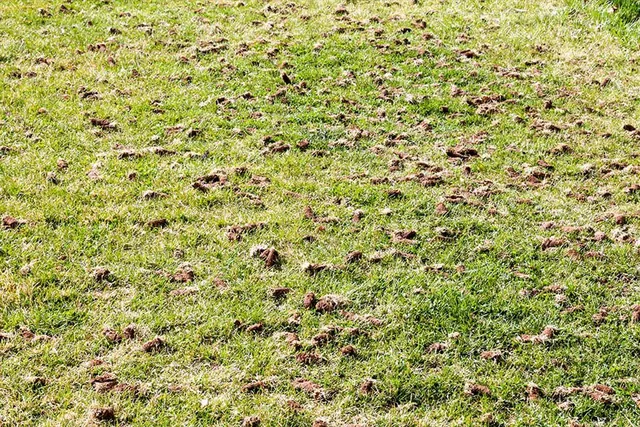
Core aeration pulls plugs of soil out of the ground and leaves them on the surface. That is different from spiking, which just pushes a hole and compresses the soil around it. Pulling a core creates real space: air, water, fertilizer and seed all get into the root zone instead of sitting on the lid.
Leave the cores where they fall. They look untidy for a week and then break down, returning soil and microbes to the surface. Raking them up throws away half the benefit.
Do it in early fall
September into early October is the best window in the GTA. The soil is still warm enough for fast germination, nights are cooling, rain is more reliable, and the weeds that would outcompete new seed in spring are winding down. Aeration paired with overseeding at that time of year does more for a tired lawn than any other single service.
Spring aeration is possible and sometimes necessary, but new seed then has to compete with crabgrass through the hottest part of the year.
What it will not fix
Aeration relieves compaction. It does not fix grade. If water sits in the same corner after every storm, the soil there is anaerobic and no amount of aerating and seeding will hold — that is a drainage job first.
Free estimate
Questions about your own property?
Call or text 647-621-8592, or send a photo and the address.